Click. Click. Scammed.
Define “Scammed” in 2026.


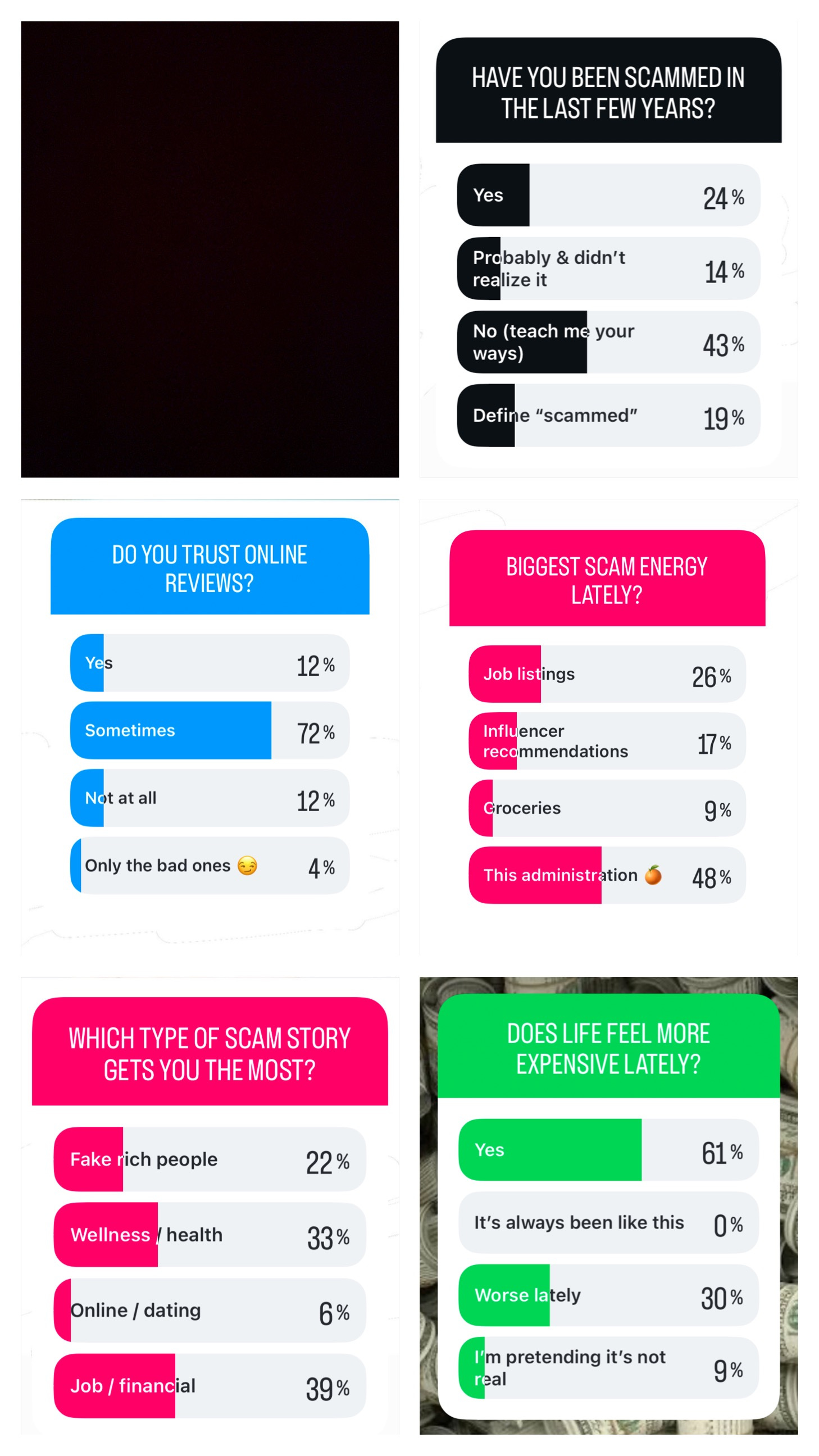
I asked Instagram recently if people had been scammed in the last few years, and honestly, the most illuminating answer wasn’t yes or no. It was:
“Define scammed.”
Which feels… deeply correct.
Because at this point, what is a scam exactly? Is it someone stealing your credit card information? A fake job posting harvesting your data? A wellness influencer selling powdered anxiety relief for $74.99? A concert ticket that starts at $40 and somehow ends up costing $113 after fees, taxes, processing charges, emotional damages, and whatever the fuck a “venue improvement surcharge” is?
Not everything is technically a scam. But enough things feel slightly dishonest, manipulative, overpriced, misleading, or intentionally exhausting that a lot of us have started walking through life like suspicious raccoons digging through the trash looking for hidden motives.
And honestly? I don’t think we’re paranoid.
I think we’re tired.
In our house, the biggest scam energy lately has absolutely been job hunting. Dwight has been searching for work, and I swear half the internet feels like it was created by a bored supervillain trying to steal social security numbers. Fake listings. Vague listings. “Urgently hiring!” postings that apparently aren’t urgent enough to ever call anyone back. Employers asking for master-level qualifications, ten years of experience, open availability, a positive attitude, and your firstborn child in exchange for $17 an hour and a pizza party every third Thursday.
A shocking amount of listings want all of your information while giving almost none of theirs. It’s like:
“Upload your resume, references, work history, blood type, and deepest childhood fears.”
And then you never hear from them again.
Cool cool cool.
When I asked Instagram what currently has the biggest “scam energy,” the top answer wasn’t influencers or groceries or even fake reviews. It was government and politics. Right behind that? Job listings.
And honestly, that says something bigger than partisan politics. People don’t just feel financially strained right now—they feel manipulated. They feel squeezed. They feel like systems that are supposed to function normally are instead operating like poorly disguised casino games.
You know what else feels vaguely fraudulent?
Grocery shopping.
Every single thing costs more.
Every. Single. Thing.
My favorite snacks are all at least a dollar more expensive now. Gas feels like a personal attack. Kids activities somehow cost the same amount as what my parents probably paid for a semester of community college in 1998. We used to get food delivered once in a while because it felt convenient and fun. Now I’ll drive to pick it up myself out of pure spite.
On Cinco de Mayo we got takeout Mexican food for the family. Six tacos, rice, beans, and chips cost over fifty dollars.
Fifty.
Dollars.
For tacos.
At one point during checkout I think the cashier actually made direct eye contact with me while removing organs from my body for resale.
And the worst part is that this isn’t even unique anymore. Everybody I know is saying some version of:
“How are people actually surviving right now?”
Not thriving. Not saving. Surviving.
I constantly think about parents working minimum wage jobs while paying childcare workers over $20 an hour to watch their children so they can go make less than that. That isn’t a personal failure.
That’s a system that no longer makes logical sense.
And somehow in the middle of all of this financial exhaustion, we’re also navigating an internet that increasingly rewards manipulation.
The bigger the drama, the bigger the clicks.
The more outrageous the headline, the more engagement.
The more emotional the content, the more profitable it becomes.
I’ve fallen for wellness bullshit before. Absolutely. During COVID and my first pregnancy especially, I got sucked into some of the crunchy wellness pipelines floating around online. MLM-adjacent nonsense. Fear-based “natural” advice. Influencers speaking with the confidence of medical professionals because they had beige aesthetics and ring lights.
COVID honestly snapped me out of a lot of it.
I had family members working in healthcare. We saw firsthand what misinformation was doing to people. Real people. Real deaths. Real panic. And suddenly I realized how easy it is to fall into narratives when you’re scared and overwhelmed and desperately looking for certainty.
And because apparently the universe wanted to personally reinforce my thesis while I was writing this article, I’ve also been watching The Real Housewives of Beverly Hills. Naturally.
This season introduced Amanda Frances, a millennial “money manifestation” guru whose entire brand revolves around becoming “rich as fuck” and referring to herself as “The Money Queen”—which, admittedly, is a level of confidence I can only aspire to while eating stale Goldfish crackers off my toddler’s car seat.
And honestly? At first I was excited to see someone closer to my age on the show. A fellow millennial! Someone who maybe understood growing up with student loans, the 2008 recession, girlboss culture, Instagram entrepreneurship, and the collective psychological damage of hearing:
“You can do anything if you hustle hard enough.”
during every formative year of our lives.
But the deeper the season went, the more uncomfortable it became.
Amanda Frances has built a multimillion-dollar business selling manifestation courses and financial empowerment coaching to women through expensive digital programs centered around “money energetics” and mindset work. Critics—including fellow cast members—have openly accused her of “scamming,” while supporters argue she’s simply teaching confidence, abundance, and entrepreneurship in a modern way.
And THAT is exactly what fascinates me.
Because this is where modern scam culture gets blurry.
Not every questionable thing is criminal.
Not every manipulative thing is illegal.
Not every charismatic person is technically lying.
But we are absolutely living in an era where confidence is often mistaken for expertise, aesthetics are mistaken for credibility, and vulnerable people are being sold certainty at premium pricing.
Which, to be fair, is basically the entire internet now.
And look—I actually think some of Amanda’s ideas are probably helpful. Positive thinking matters. Confidence matters. Mindset matters. I’m not above manifesting a Target gift card and emotional stability for myself. But there’s also something deeply unsettling about telling financially stressed people that wealth is primarily a mindset issue while charging thousands of dollars for digital courses about abundance.
That’s not just a reality TV subplot.
That’s modern America, baby.
I’ve also been directly scammed before. When I was a couple months pregnant with Declan, I fell for a phishing scam that honestly scared the shit out of me. The scammers already had some of my information, which immediately made everything feel legitimate. That’s the thing about modern scams—they rarely start with a Nigerian prince asking for your bank account anymore.
They start with enough truth to lower your guard.
I ended up locking my credit for years until we bought our house because I was terrified someone was going to open accounts in my name. I’m pretty sure my social security number is currently floating around the dark web next to a Hotmail password from 2007 and some deeply embarrassing Facebook statuses.
Joke’s on them though. If anyone steals my identity, enjoy the overwhelming responsibility of paying for three children and overpriced tacos.
That’s the thing I keep coming back to:
Most people who get scammed are not stupid.
They’re hopeful.
Or exhausted.
Or lonely.
Or broke.
Or grieving.
Or trying to heal.
Or trying to survive.
Or trying to believe someone has the answer.
That’s why scams work.
Not because victims are dumb—but because perpetrators are malicious.
Researchers studying online fraud consistently find that scammers exploit normal human psychology—not stupidity. Studies show scams are especially effective when people are financially stressed, lonely, emotionally vulnerable, or overwhelmed by uncertainty.
Which honestly describes… a huge percentage of the population right now.
And unfortunately, the modern internet has industrialized manipulation in a way we’ve honestly never seen before.
AI now makes clickbait easier than ever. Fake photos. Fake articles. Fake voices. Fake reviews. Fake urgency. Fake expertise. Entire accounts built around rage bait and engagement farming. Sometimes I scroll social media and genuinely feel like I’m wandering through a digital carnival where every booth is trying to emotionally mug me.
And the scams themselves are getting more sophisticated in ways that are honestly terrifying. Officials have warned about scammers using AI-generated images and fake emergencies to emotionally manipulate people into sending money immediately. The FBI has also warned about AI voice cloning scams using fake audio of loved ones.
Which is genuinely dystopian.
We’ve somehow entered an era where:
“That doesn’t even sound real.”
is no longer comforting.
And the scary part is… sometimes the manipulation works even when we know it’s manipulation.
That’s what fascinates me most.
According to FTC and FBI data, Americans reported billions of dollars lost to internet scams and fraud in the last year alone, with social media scams rapidly increasing. Which makes sense considering half the internet now feels like:
“Hey girl! I made six figures working from home while healing my gut biome. DM me 💕”
According to my Instagram poll, only a small percentage of people confidently said they’d been scammed recently. But a huge chunk answered:
“Probably and didn’t realize it.”
That feels like the defining mood of 2026.
Not certainty.
Not trust.
Not confidence.
Just:
“Honestly? Maybe.”
I also asked people whether they trust online reviews anymore. Most answered “sometimes,” which honestly might be the most modern response imaginable. We no longer fully trust institutions, influencers, reviews, politicians, brands, or media—but we still rely on them anyway because what other option do we have?
We still need jobs.
We still need groceries.
We still need childcare.
We still need information.
We still need community.
And I think underneath all the sarcasm and cynicism, what people are actually craving right now is security. Stability. Transparency. Some kind of honest human connection that doesn’t immediately turn into a sales funnel.
I don’t think people want perfection anymore.
I think they just want reality.
Like:
“Can one thing please just cost what it says it costs?”
Can a product review be real?
Can a job posting be real?
Can a politician say what they mean?
Can an influencer recommend something without secretly making commission?
Can a headline exist without trying to spike my cortisol levels for ad revenue?
I know that sounds dramatic, but I genuinely think something deeper is happening culturally. We’re losing our default assumption of honesty. And once that starts eroding, everything begins to feel a little unstable.
The scary part isn’t just that scams exist.
It’s that modern life increasingly rewards scam-like behavior.
Not everything is a scam.
But enough things feel slightly off that we’ve started questioning everything.
Which honestly feels bad for society! Love that for us!
Still, despite all of this, I don’t think the answer is to become completely cynical. I don’t want to live my life assuming every person is secretly trying to exploit me. That sounds fucking miserable. I still believe most people are good. I still believe community matters. I still believe truth matters. I still believe there are honest people trying to do meaningful work.
But I also think we’re living in an era where attention has become currency, outrage has become marketing, and trust has become increasingly difficult to earn.
Click.
Click.
Scammed.
And somewhere underneath all the noise, I think most of us are just trying to figure out what’s still real.
If You’d Like to Spiral Further…
Inventing Anna — Fake heiress scams rich people. Honestly iconic until you remember the crimes.
The Tinder Swindler — Dating apps but make it financial warfare.
Bad Vegan — Wellness culture and emotional manipulation with a side of immortal dog promises.
Apple Cider Vinegar — Influencer wellness fraud wrapped in aesthetically pleasing fonts.
LuLaRich — MLM culture somehow worse than you already assumed.
The Vow — A cult disguised as networking and self-improvement.
Love Has Won: The Cult of Mother God — Every five minutes you’ll whisper, “What the fuck?”
Keep Sweet: Pray and Obey — Religious extremism hidden behind “family values.”
Shiny Happy People: Duggar Family Secrets — Proof that wholesome branding means absolutely nothing.
Escaping Twin Flames — Algorithmic soulmates and deeply online manipulation.
The Way Down: God, Greed, and the Cult of Gwen Shamblin — Diet culture and church trauma join forces.
Wild Wild Country — Somehow everyone involved feels brilliant and terrifying.
Q: Into the Storm — The internet completely losing the plot in real time.
Telemarketers — One of the most “everything is fake” documentaries ever made.
The Dropout — Corporate fraud with black turtlenecks and fake deep voices.
WeCrashed — Startup culture fueled entirely by vibes and delusion.
Fake Famous — Influencer culture exposed as collective internet hallucination.
Bitconned — Crypto bros doing crypto bro things.
Emily the Criminal — Late-stage capitalism but make it stressful.
Sharper — Rich people professionally lying to each other.
Notes
Federal Trade Commission consumer fraud resources: FTC Consumer Protection Resources
FBI internet crime and fraud reporting data: FBI Internet Crime Complaint Center (IC3) Reports
Research on scam psychology and emotional manipulation tactics: Oxford Academic Cybersecurity Research on Scam Communication
Overview on why people fall for scams: Verywell Mind – Why Even Smart People Fall for Scams
AI deepfake and voice-cloning scam reporting: Axios Reporting on AI Voice and Kidnapping Scams
Reporting on AI-generated emotional scam tactics: Connecticut Insider Coverage of AI Pet Scams
Coverage of Amanda Frances and criticism surrounding manifestation-based coaching businesses: Decider coverage of RHOBH controversy
Profile on manifestation culture and Amanda Frances branding: The Cut feature on Amanda Frances
PEOPLE interview discussing RHOBH backlash and Amanda Frances’ business model: PEOPLE interview with Amanda Frances
I read your thoughts today and I went to check what's up on Ryan Christian at https://x.com/TLAVagabond . He links to something on twitter and youtube-- https://youtube.com/watch?v=zQpp0lw8JgA , David Icke saying the world is a scam, right out of the gate. All sorts of malicious actors high and low, who must find comfort in some sort of security. One of Judge Napolitano's guests today-- https://x.com/Judgenap , Col. Douglas Macgregor, described them as 'sycophantic head-bangers' ensconced as Pentagon officials and White House aides, in a typical 25 minute interview, 15:50 in.